

Improve Your Resume: Soft Skills and How to Highlight Them
A survey conducted by Resume Genius of 625 hiring managers found that 48% consider soft skills a “must-have,” and 28% said they are even more important than hard skills.
So, why do employers value soft skills so highly? How do they differ from hard skills, and how can you highlight soft skills on your resume?
Soft Skills vs Hard Skills
Hard skills are related to technical knowledge and are quantifiable. These skills can be developed through training and schooling, and they are often specific to a particular job or industry. For example: certifications, education, or typing skills.
Soft skills are personality traits that speak to how you work and interact with others. They help employers understand your overall abilities and how well you will fit in with company culture. Soft skills are more subjective, harder to quantify, but are easily transferable between careers. For example: problem solving skills, creativity, and adaptability.
Unlike hard skills, soft skills can’t be learned in a classroom or through training. They come from personal growth over time. This is why employers value them so much. While it’s possible to train someone in technical skills, it’s much harder to teach things like managing time, having a strong work ethic, or being creative.
Figuring out what Soft Skills Employers Want
To figure out which soft skills an employer is looking for, read the job posting carefully. Whether you print it or review it on screen, make note of any soft skills that appear. Some common soft skills to watch for include:
- Time Management – Organizing tasks and managing time efficiently
- Communication – Sharing ideas clearly, both verbally and in writing
- Teamwork – Collaborating effectively with others
- Adaptability – Adjusting to changes smoothly
- Problem-Solving – Using logical and creative thinking to overcome challenges
- Creativity – Developing innovative solutions or approaches
- Leadership – Guiding, mentoring, and supporting others
- Work Ethic – Showing dedication and responsibility
- Organization – Keeping track of materials, information, and tasks
- Interpersonal Skills – Building positive relationships with others
Here is a sample job posting for an Administrative assistant role (a PDF version of the example job posting is available here).
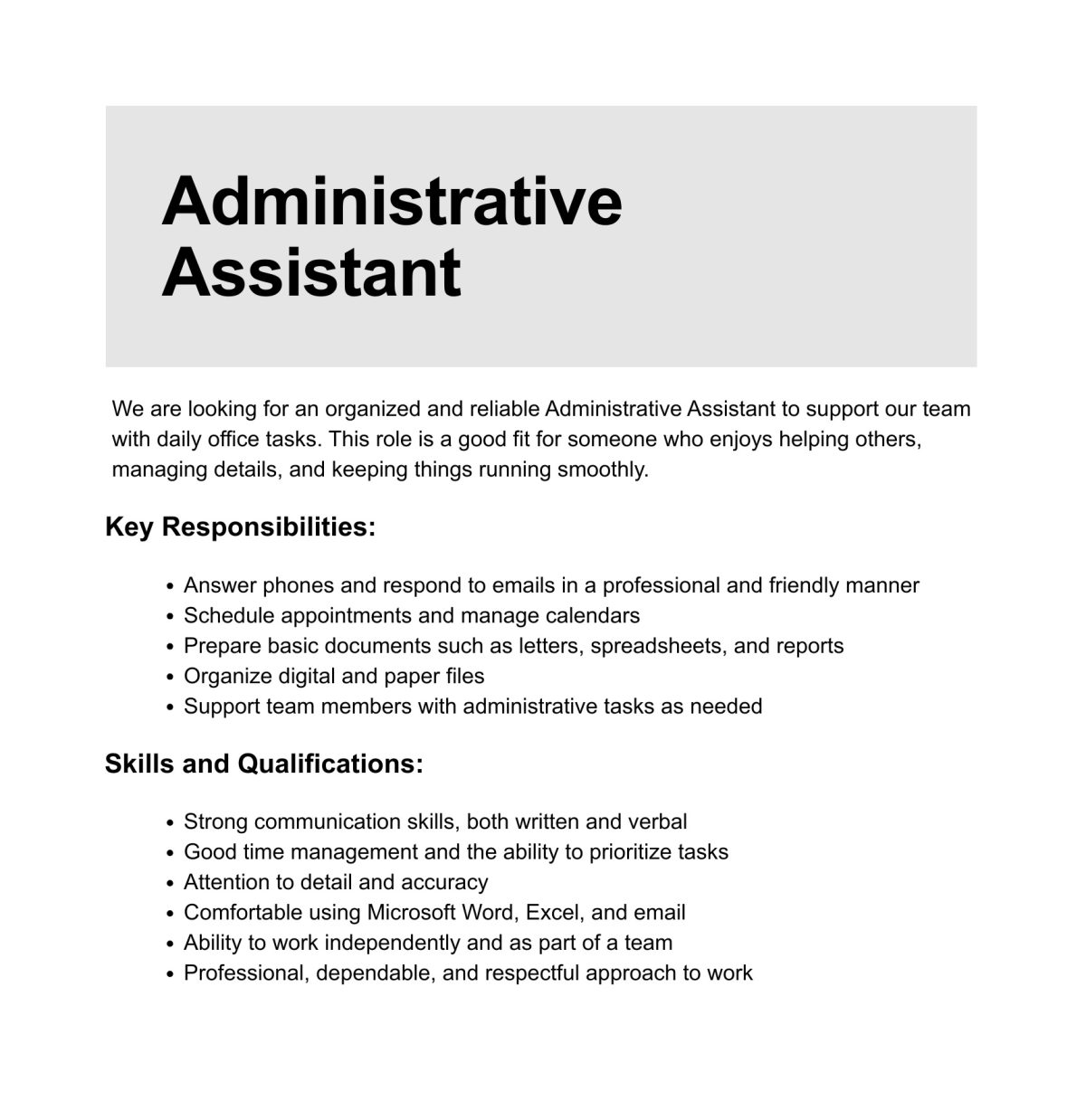
In this job posting there are a number of hard and soft skills mentioned. Let’s focus on the soft skills. Take a moment to note the soft skills in the posting,
Here is the same job posting with soft skills in bold (a PDF version of the example is available here):
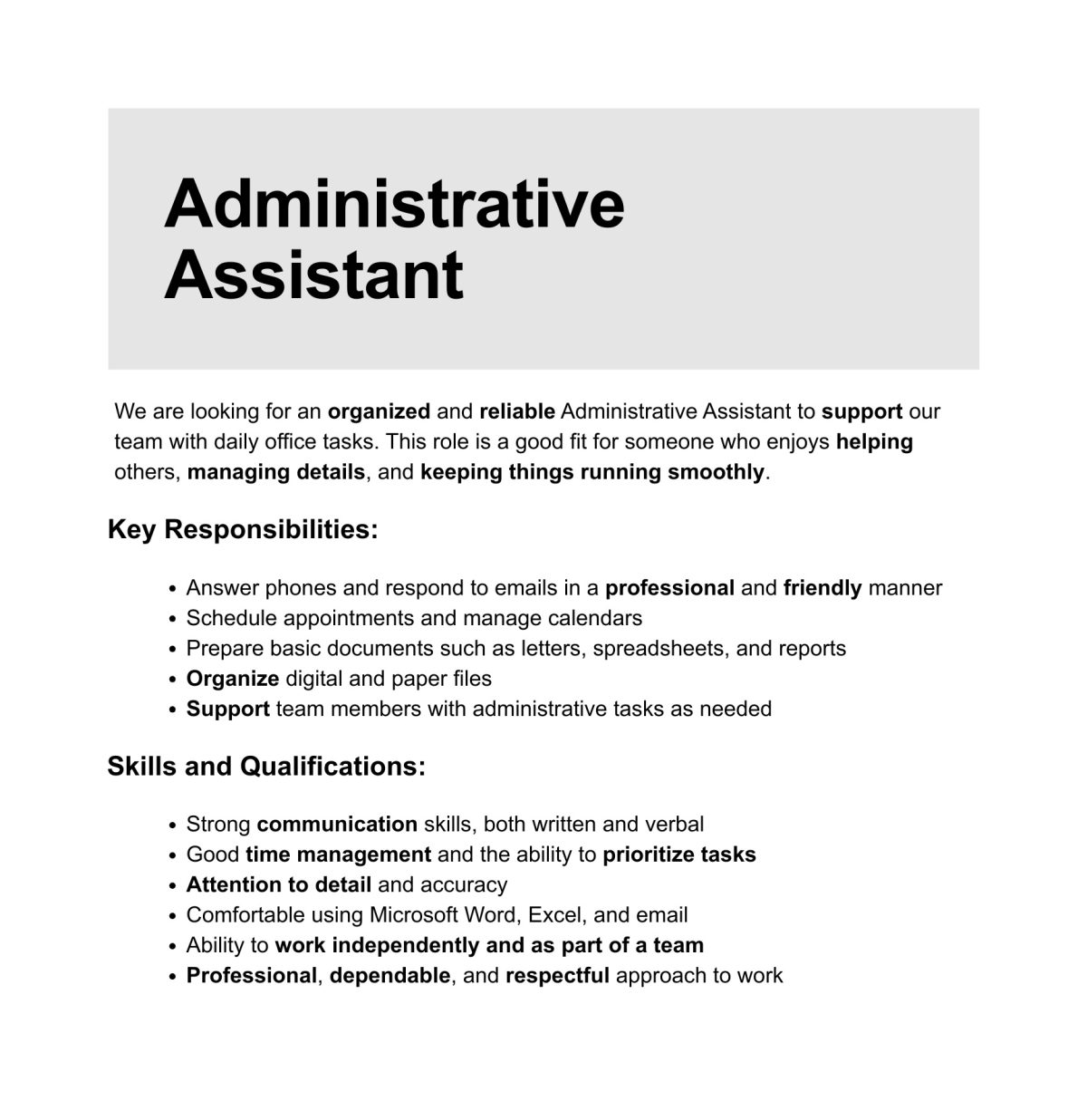
There are a few soft skills that are mentioned more than once, often in different ways. For example, “Support” is mentioned twice, and “helping” is also mentioned. Chances are good that being supportive is an important soft skill the employer is looking for.
Soft skills can be organized into categories with common themes. For example, communication, professional, teamwork, respectful, and friendly can be grouped together as communication and interpersonal skills.
Here is an example of how the soft skills from this job posting can be organized into 3 main categories:
Communication and interpersonal skills
- Written and verbal communication
- Professional and friendly manner
- Teamwork and collaboration
- Respectful approach to work
Organization and time management
- Time management
- Prioritization
- Organization
- Attention to detail
- Accuracy
Work ethic and adaptability
- Reliability and dependability
- Professionalism
- Ability to work independently
- Adaptability and willingness to support others
By grouping the skills the employer is looking for, you help draw attention to what you do well. Think about times you have used these skills in a work, volunteer, or school setting. When adding skills to your resume, be honest and realistic. Only include skills you truly have, and avoid exaggerating or overstating your experience.
Skill categories are a great way to customize your resume and highlight both your soft and hard skills. Creating sections in your resume such as “Relevant Professional Experience” or “Highlights of Skills” makes it easier for employers to quickly identify your strengths. This approach can be especially helpful if you do not have the exact education or work experience the employer is requesting.
To tailor your resume even further, create skill statements to highlight how you have used these skills.
Writing Skill Statements
Employers are looking for more than a simple list of skills on a resume. They want to understand how you have used those skills in real work situations and what kind of results they helped you achieve. This is where well-written skill statements can really strengthen your resume.
A skill statement starts by describing a situation, task, or problem you worked on or helped solve. For example, you might have worked as part of a team on a project, kept records organized, served customers, or coordinated with contractors. Each of these situations required you to use soft skills to do your work effectively.
The next part of a skills statement explains the action you took. This is where you describe how you addressed the situation or solved the problem, and which skills you used. Review the skills listed in the job posting and try to use similar wording where it fits naturally. For example, if you organized files, did you do so accurately? If you coordinated with contractors, did you communicate in a professional way? If you supported customers, were you friendly and helpful?
The final part of a skills statement focuses on the result. This is where you show the outcome of your actions and the impact of your work. Did providing friendly customer service lead to higher customer satisfaction or repeat business? Did professional communication with contractors help ensure renovations were completed on time? Whenever possible, try to quantify your results. Using numbers, such as a percentage increase in sales, can make your skill statement even stronger.
Let’s look at a few examples to show how a skills statement comes together.
| Situation | Action | Result |
| Handled cash, debit, and credit transactions | Accurately and in a friendly and professional manner | Decrease in errors and increase in customer satisfaction |
Skill Statement examples:
- Handled cash, debit, and credit transactions accurately while providing friendly service, resulting in fewer errors and higher customer satisfaction.
- Accurately completed customer transactions and resolved minor issues at the register in a friendly manner, contributing to a decrease in errors and an increase in customer satisfaction.
- Processed customer transactions with accuracy and professionalism, helping to reduce errors and improve the checkout experience for customers.
| Situation | Action | Result |
| Filing paperwork | Organized, time management, and prioritization | Information was ready and available for team when needed |
Skill Statement examples:
- Managed filing and documentation tasks with strong time management and prioritization, supporting the team by keeping records accessible and up to date.
- Maintained accurate and organized paperwork, making information easily available to colleagues and contributing to smooth team operations.
- Effectively organized and prioritized filing tasks, ensuring timely access to documents and supporting overall team productivity.
Each of these statements highlights skills, experience, and your ability to contribute to an organization.
Bringing it all together
Adding soft skills to your resume is about more than just listing abilities—it’s about showing employers how you apply those skills and the results you achieve. One of the best ways to do this is by carefully reviewing the job posting to identify the skills the employer values most, and then highlighting those skills that you have in your resume. By organizing your skills thoughtfully and tying them to real-world examples, you make it easy for employers to see your strengths.
If you’re looking for additional support in building your resume, identifying your skills, or preparing for your job search, your local WorkBC Centre can help.
You can also explore our other blog post for more tips on job search strategies:
-
Improve Your Resume: Soft Skills and How to Highlight Them
A survey conducted by Resume Genius of 625 hiring managers found that 48% consider soft skills a “must-have,” and 28%…
-
What Is an ATS? And How to Make Your Resume Stand Out (to Robots and Recruiters)
Applying for a job today can sometimes feel like sending your resume into a void. A big reason for this… Continue reading “What Is an ATS? And How to Make Your Resume Stand Out (to Robots and Recruiters)”…
-
Making the Most of a Career Fair: A Guide for Job Seekers
Career fairs (also called job fairs or hiring events) are exciting opportunities to meet potential employers, learn about job openings,… Continue reading “Making the Most of a Career Fair: A Guide for Job Seekers”…
Sources:
LinkedIn – Most In-Demand Hard and Soft Skills
LinkedIn. (n.d.). The most in-demand hard and soft skills. LinkedIn. https://www.linkedin.com/business/talent/blog/talent-strategy/linkedin-most-in-demand-hard-and-soft-skills
ResumeGenius – Soft Skills
ResumeGenius. (n.d.). Soft skills: Definition, examples, & how to put on a resume. https://resumegenius.com/blog/resume-help/soft-skills
LMIC-CIMT – Connecting Skills Report
LMIC-CIMT. (n.d.). Connecting skills: Using online job postings to unravel the demand for skills in the labour market. https://lmic-cimt.ca/connecting-skills-using-online-job-postings-to-unravel-the-demand-for-skills-in-the-labour-market/?utm_source=LMIC-CIMT+Web+Subscribers&utm_campaign=27234cfb8e-LMIC_NEWSLETTER_2025_01_28_ENGLISH&utm_medium=email&utm_term=0_-a4d3d4fd7d-505312253